ISO/IEC JTC 1/SC34 N0344

ISO/IEC JTC 1/SC34
Information Technology --
Document Description and Processing Languages
12 November 2002
JTC
1/SC 34 N 344
This Reference Model for ISO
13250 Topic Maps (RM4TM) provides a framework for
the definitions of Topic Map Applications (TM
Applications). Diverse topic maps that conform
to diverse TM Applications that are defined in
keeping with this framework can be interpreted
and amalgamated automatically by
independently implemented systems, without losing
information, and with predictable results.
Many of the key advantages of
the Topic Maps paradigm derive from the
achievement of its primary objective, the
"Subject Location Uniqueness Objective", which is
to make everything known about every subject in a
topic space accessible from a single location
within that space. The achievement of the
Subject Location Uniqueness Objective means that
the efficiency with which users can find
information is maximized, not only because the
subject's single location, once found, acts as a
comprehensive catalog of the things that are
known about it, but also because the subject's
location can be found in terms of any of its
relationships to other subjects.
This RM4TM facilitates the
development of TM Applications and systems that
can achieve the Subject Location Uniqueness
Objective with respect to all subjects, including
those that are only implicit in interchangeable
topic map instances, as well as with respect to
subjects that are relationships (and aspects of
relationships) among other subjects.
Moreover, this RM4TM
facilitates the development of TM Applications
and implementations that can amalgamate the topic
spaces represented by topic maps that conform to
diverse Topic Maps Applications into a single
resulting topic space in which each subject has a
single location, there is no redundant
information, and all of the information
represented by the comprising topic maps is
preserved.
This RM4TM provides definition
requirements for user-defined Topic Map
Applications that allow such definitions to serve
as contracts between topic map creators, users,
and system implementers, such that when the
interchange or amalgamation of topic maps fails
due to nonconformance to the definition of a
Topic Maps Application, the nonconforming aspects
of the topic maps or system implementations can
be identified.
This RM4TM defines:
-
an abstract graph
structure for the
representation of relationships between
subjects;
-
rules for defining
Applications of the Topic Maps paradigm; and
-
rules for processing
the information contained in topic
maps.
| Note 1: |
See Annex A for a brief informal
overview of this RM4TM.
|
|
| Editor's Note 1: |
(The glossary hasn't been
drafted yet.)
|
| 3.1 |
The common structural
abstraction for topic maps |
This RM4TM defines an
abstract structure, called a "topic map graph",
in terms of which all kinds of topic maps can
be uniformly interpreted, regardless of their
governing TM Applications, and regardless of
the TM Application-defined interchange syntaxes
in which they may be representable.
The "topic map graph" form of
any given topic map represents all of the
subjects that participate in the topic map
explicitly, even if they were only implicitly
represented in the interchangeable form of the
given topic map.
The following subclauses
name and define the rules and cases to which
topic map graph components and entire topic map
graphs must conform in order to be considered
"well formed", and the additional rules to
which topic map graphs must conform in order to
be considered "fully merged". Topic map graphs
that are under construction may or may not be
well-formed, but only well-formed topic map
graphs are eligible to become fully merged,
in addition to being well-formed.
| 3.2 |
Topic map graphs consist of
nodes and arcs. |
A topic map graph consists
of nodes and arcs. In a well-formed topic map
graph, every arc is a typed, oriented
connectedness of two nodes, and every node is
one of the two endpoints of zero or more arcs.
| Note 2: |
This RM4TM uses the
neologism "connectedness" in order to avoid
implying that TM Applications must be
implemented in such a way that arcs are
represented as a data structure. For
example, The arc abstraction can be fully
honored by the property values of the nodes
that serve as its endpoints.
|
|
| Note 3: |
The reader's understanding
of the remainder of this clause 3 is likely to be aided by
referring to the informative "Assertion
Diagrams" Annex B.
|
|
An "arc" in a topic map graph
is a two-ended connectedness between nodes that
satisfies all of the following criteria:
-
it has two
different nodes serving as its two
endpoints, and
-
it is one of the
eight forms of connectedness enumerated in
3.3.3 between the
nodes that serve as its two endpoints.
(This necessarily means that it is one of
the four arc types enumerated in 3.3.1.)
There are four arc types,
named "AT", "AC", "CR", and "Cx". The
significance of each type of arc is
different.
| 3.3.2 |
Names of arc types and
arc endpoint types |
The first letter of an arc
type's name is the name of one of its
endpoint types. The second letter of the arc
type's name is the name of its other endpoint
type. That is, an AT arc has two endpoints,
one of endpoint type "A" and the other of
endpoint type "T".
| Note 4: |
In a well-formed topic
map graph, only a-nodes serve as "A"
endpoint types, only c-nodes serve as "C"
endpoint types, only r-nodes serve as the
"R" endpoint types, and only t-nodes serve
as the "T" endpoint types. There is no such
thing as an "x-node", because all kinds of
nodes are eligible to serve as the x
endpoints of Cx arcs. The
exceptional character of the
x endpoints of Cx arcs is the
reason why "x" is the only endpoint
type name that is always rendered in lower
case.
|
|
| 3.3.3 |
Eight forms of
connectedness are possible |
In all instances of each
type of arc, the significance of a node's
service as one of the endpoints is different
from the significance of a node's service as
the other endpoint. Given two nodes, N1 and
N2, there are eight possible forms of
connectedness between them, since there are
four types of arcs. They are enumerated in
the following subclauses.
The connectedness of N1
and N2 is an instance of an AT arc type in
which N1 is the A endpoint, and N2 is the T
endpoint.
The connectedness of N1
and N2 is an instance of an AT arc type in
which N1 is the T endpoint, and N2 is the A
endpoint. (This is the reverse of Form
1.)
The connectedness of N1
and N2 is an instance of an AC arc type in
which N1 is the A endpoint, and N2 is the C
endpoint.
The connectedness of N1
and N2 is an instance of an AC arc type in
which N1 is the C endpoint, and N2 is the A
endpoint. (This is the reverse of Form
3.)
The connectedness of N1
and N2 is an instance of a CR arc type in
which N1 is the C endpoint, and N2 is the R
endpoint.
The connectedness of N1
and N2 is an instance of an CR arc type in
which N1 is the R endpoint, and N2 is the C
endpoint. (This is the reverse of Form
5.)
The connectedness of N1
and N2 is an instance of a Cx arc
type in which N1 is the C endpoint, and N2
is the x endpoint.
The connectedness of N1
and N2 is an instance of a Cx arc
type in which N1 is the x endpoint, and N2
is the C endpoint.
| Note 5: |
The above list of Forms
of Connectedness can be represented in
tabular form as follows:
|
N1 |
N2 |
| 1 |
| A |
T |
| T |
A |
| A |
C |
| C |
A |
| C |
R |
| R |
C |
| C |
x |
| x |
C |
|
| 2 |
| 3 |
| 4 |
| 5 |
| 6 |
| 7 |
| 8 |
|
|
| Note 6: |
The above enumeration of
the Forms of Connectedness serves two
purposes in this RM4TM:
-
It establishes a
name ("Form n", where n is an integer
in the sequence 1..8) for each of the
Forms of Connectedness that an arc can
represent, as a convenience for use
elsewhere in this document, and
possibly in the definitions of TM
Applications.
-
It establishes
that the orientation of the
connectedness represented by an arc is
an essential aspect of the definition
of "arc" in this RM4TM. For purposes
of a TM Application's definition of a
"situation feature" (see 3.4.2), for example, it
is insufficient merely to say that two
nodes are connected by a certain type
of arc. The specification of the arc
must also include information as to
which node serves as which endpoint
type. In order to represent
connectedness equivalent to the
connectedness represented by an RM4TM
arc in some "directed graph" paradigms,
at least two directed graph arcs must
be used, plus whatever additional
machinery may be required to associate
the two directed graph arcs in order to
represent that both represent different
directional aspects of the same
connectedness. By contrast, RM4TM arcs
are nondirectional, but
oriented.
|
|
| 3.4.1 |
One subject for each node |
In topic map graphs, only
nodes can represent subjects, and every node
represents a single subject.
| 3.4.2 |
Situations and subjects |
A node serves as one
endpoint of zero or more arcs.
| Note 7: |
A node that serves as the
endpoints of no arcs at all is not
well-formed unless it has at least one
built-in SIDP value. (See 3.4.2.)
|
|
A node that is the endpoint
of zero arcs is said to be "isolated." In a
well-formed topic map graph, only "built-in"
nodes (see Clause 4) can be isolated.
A node that is the endpoint
of one or more arcs is said to be "situated."
A node's "situation" is its service as one of
the endpoints of all of the "connected paths"
through the graph to all other nodes
accessible via such paths. (Given node n[0],
a "connected path" is a finite alternating
sequence n[0], arc[1], n[1], arc[2],
n[3]... n[n] such that each arc[i] in the
sequence connects node[i-1] and
node[i].)
Except for the built-in
values of the properties of built-in nodes,
all of the values of the properties of nodes
are determined by their situations. Thus,
except for the built-in subjects of built-in
nodes, the subjects of all nodes are entirely
determined by their situations.
Except for the restrictions
on the subjects of nodes that have special
functions within assertion subgraphs (see
3.6.2.2), TM
Applications are free to define "situation
features" (features of the situations of
nodes) and how those features, when they
occur, affect the values of the properties of
the nodes whose situations include those
situation features. The values of all properties can
be affected by such situation features,
including both Subject Identity
Discriminating Propertes (SIDPs) and Other
Properties (OPs), in accordance with the
specifications provided in the definition of
the TM Application that defines the
properties and the situation features (see
4.7.2.2).
| Note 8: |
The situation of a node
in a topic map graph is always and only as
visible as the values of its properties
make it. See Clause 4.
|
|
| Note 9: |
The definition of a
situation feature can include, but is not
limited to, the situated node's status as a
role player in one or more assertions. The
definition of a situation feature can also
include the situated node's status as
another kind of assertion component node,
such as an r-node component of one or more
assertions (see 3.6.2.2).
|
|
| 3.5.1 |
Six cases of well-formed nodes |
A node that satisfies all
the criteria in the subclauses of one of the
six cases described in the following
subclauses is well formed. A node that does
not satisfy the criteria of one of the six
cases is not well formed.
| 3.5.1.1.1 |
Defining
Characteristics of Case 1 nodes |
| 3.5.1.1.1.2 |
The node has at
least one built-in SIDP value (see
Clause 4). |
Case 1 nodes do not
have a node type name.
The subjects of Case 1
nodes are not constrained by this RM4TM.
| 3.5.1.2.1 |
Defining
characteristics of Case 2 nodes |
| 3.5.1.2.1.1 |
The node serves as
one or more of the x endpoints of any
number of well-formed Cx
arcs. |
| 3.5.1.2.1.2 |
The node does not
serve as any other endpoint type of any
instance of any arc type. |
| 3.5.1.2.1.3 |
The node either has
at least one built-in SIDP value, or
its situation as a role player causes
at least one SIDP value to be conferred
upon it. |
Case 2 nodes do not
have a node type name.
The subjects of Case 2
nodes are not constrained by this
RM4TM.
| 3.5.1.3 |
Well-formed node Case
3 ("a-node") |
| 3.5.1.3.1 |
Defining
characteristics of Case 3 nodes |
| 3.5.1.3.1.1 |
The node serves as
zero or more of the x endpoints
of any number of Cx arcs. |
| 3.5.1.3.1.2 |
The node serves as
the A endpoint of two or more AC
arcs. |
| 3.5.1.3.1.3 |
The node may or may
not serve as the A endpoint of one AT
arc. |
| 3.5.1.3.1.4 |
The node does not
serve as any other endpoint of any
instance of any arc type. |
A Case 3 node is
called an "a-node" (where "a" stands for
"assertion").
The subject of an
a-node is always the relationship that is
specified via the assertion for which it
serves as the unique nexus. The
relationship is an instance of the type
of relationship which is the subject of
the node that serves as the T endpoint of
the AT arc of which the a-node is the A
endpoint, if any. If the a-node is not
the A endpoint of an AT arc, the type of
the relationship is unspecified.
| 3.5.1.4 |
Well-formed node Case
4 ("c-node") |
| 3.5.1.4.1 |
Defining
characteristics of Case 4 nodes |
| 3.5.1.4.1.1 |
The node serves as
zero or more of the x endpoints
of any number of Cx arcs. |
| 3.5.1.4.1.2 |
The node serves as
the C endpoint of a single AC
arc. |
| 3.5.1.4.1.3 |
The node serves as
the C endpoint of a single CR
arc. |
| 3.5.1.4.1.4 |
The node may or may
not serve as the C endpoint of a single
Cx arc. |
| 3.5.1.4.1.5 |
The node does not
serve as any other endpoint of any
instance of any arc type. |
A Case 4 node is
called a "c-node" (where "c" stands for
"casting").
| Note 10: |
The term "casting" is
consistent with the theatrical metaphor
invoked by the term "role player". In
an assertion, the role players are like
the actors in a stage play. Each
c-node represents the "casting" of an
actor (a role player) in a specific
role (a role type) in a specific stage
production (a specific assertion),
which may or may not be a production of
a specific stage play (a specific
assertion type). See 3.6.1.
|
|
If a c-node serves
as the C endpoint of a Cx arc,
then its subject is the playing of a
specific role type by a specific
subject in a specific
relationship.
If a c-node does not
serve as the C endpoint of a Cx
arc, then its subject is the fact that
a specific role type in a specific
relationship is not played by any
subject.
| 3.5.1.5 |
Well-formed node Case
5 ("r-node") |
| 3.5.1.5.1 |
Defining
characteristics of Case 5 nodes |
| 3.5.1.5.1.1 |
The node serves as
zero or more of the x endpoints
of any number of Cx arcs. |
| 3.5.1.5.1.2 |
The node serves as
the R endpoint of one or more CR
arcs. |
| 3.5.1.5.1.3 |
The node does not
serve as any other endpoint of any
instance of any arc type. |
A Case 5 node is
called an "r-node" (where "r" stands for
"role type").
The subject of an
r-node is a role type that can be played
by subjects in relationships. The
subjects of the c-nodes that serve as the
C endpoints of the CR arcs whose R endpoints
are the r-node are the role-player
castings of role players that play the
role type.
| 3.5.1.6.1 |
Defining
characteristics of Case 6 nodes
("t-node") |
| 3.5.1.6.1.1 |
The node serves as
zero or more of the x endpoints
of any number of Cx arcs. |
| 3.5.1.6.1.2 |
The node serves as
the T endpoint of one or more AT
arcs. |
| 3.5.1.6.1.3 |
The node does not
serve as any other endpoint of any
instance of any arc type. |
A case 6 node is
called a "t-node" (where "t" stands for
assertion "type").
The subject of a
t-node is a class of relationship,
including the roles that can be played in
instances of the class, and the values
that are conferred on the properties of
role players by virtue of their
situations as players of specific roles
in instances of the class. The subjects
of all of the a-nodes that serve as the A
endpoints of all of the AT arcs of which
a t-node serves as the T endpoint are
instances of the class of relationship
that is the subject of the
t-node.
| Note 11: |
The above
well-formedness requirements for nodes can
be summarized in tabular form as follows:
|
|
| Table 1: |
The Six Cases of Well-formed Nodes |
Form of
Connectedness
|
(node
N2)
node N1
|
| N1 Case 1 |
| N1 Case 2 |
| N1 Case 3 |
| N1 Case 4 |
| N1 Case 5 |
| N1 Case 6 |
|
8
.........
C
x |
7
.........
x
C
|
6
.........
C
R
|
5
.........
R
C
|
4
.........
A
C
|
3
.........
C
A
|
2
.........
A
T
|
1
.........
T
A
|
|
node type
name
(if
any).
|
Subject
constraint
(if any).
Subject is:
|
requires
built-n
SIDP
value(s)?
|
| 0
|
0
|
0
|
0
|
0
|
0
|
0
|
0
|
(none) |
(unconstrained) |
yes |
| 0
|
1+
|
0
|
0
|
0
|
0
|
0
|
0
|
(none) |
(unconstrained) |
no |
| 0
|
0+
|
0
|
0
|
0
|
2+
|
0
|
1?
|
"a-node" |
assertion |
no |
| 0
|
0+
|
1?
|
0
|
1
|
1
|
0
|
0
|
"c-node" |
casting |
no |
| 0
|
0+
|
0
|
1+
|
0
|
0
|
0
|
0
|
"r-node" |
role type |
no |
| 0
|
0+
|
0
|
0
|
0
|
0
|
1+
|
0
|
"t-node" |
assertion type |
no |
|
|
|
Legend: |
|
0
|
In
order to conform to the well-formed node case described on this row, node N1 is
not permitted to serve as the arc endpoint designated by this column.
|
|
0+ |
In
order to conform to the well-formed node case described on this row, node N1
may serve as zero or more of the arc endpoints designated by this column.
|
|
1 |
In
order to conform to the well-formed node case described on this row, node N1
must serve as exactly one of the arc endpoints designated by this
column.
|
|
1? |
In
order to conform to the well-formed node case described on this row, node N1
may serve as exactly one of the arc endpoints designated by this column.
|
|
1+ |
In
order to conform to the well-formed node case described on this row, node N1
must serve as at least one of the arc endpoints designated by
this column.
|
|
2+ |
In
order to conform to the well-formed node case described on this row, node N1
must serve as at least two of the arc endpoints designated by
this column.
|
|
| 3.6.1 |
Introduction to
assertions |
Assertions are subgraphs
of topic map graphs. In a well-formed topic
map graph, every arc is a specific component
of a single assertion, so well-formed topic
map graphs consist entirely of assertions
(except, possibly, for isolated "built-in"
nodes).
Each assertion represents
(asserts the existence of) a single
strongly-typed relationship among the
subjects that are its "role players". Each
role player is a subject that plays a
specific role in the relationship. The roles
("role types") themselves are subjects, and
so is the type of relationship of which the
relationship is an instance.
The design of assertions in
this RM4TM enables diverse multiple topic map
graphs to be amalgamated into a single topic
map graph, such that:
-
each of the
original topic map graphs is a subgraph
of the result, and
-
each such subgraph
is structurally identical to the
corresponding original, even when one of
them makes assertions about assertions in
the other, about which the other made no
assertions. Thus, the integrity of the
original topic map graphs is maintained
as subgraphs of the result.
| Note 12: |
In order to maintain the
integrity of merged topic maps, it is
necessary to establish a common structure
for all assertions. In this RM4TM, the
decisions as to which aspects of the
structure of assertions should be "reified"
as nodes, and which aspects should remain
"unreified" as arcs, were made by
distinguishing between the aspects of
assertions that are substantive with
respect to the relationships that they
assert (and that could conceivably,
therefore, need to become role players in
other assertions about those
relationships), as opposed to the aspects
of assertions that nobody would want to
make other assertions about unless they
were discussing the design of assertions in
general. In the structure of assertions
set forth in this RM4TM, the former aspects
are represented by a-nodes and c-nodes,
while the latter aspects are represented as
the four types of arcs (the "eight forms of
connectedness").
|
|
| 3.6.2 |
Inventory of the
components of assertions |
An assertion is a subgraph
of a topic map graph that consists of certain
arcs and the nodes that serve as their
endpoints, constructed in conformance to the
rules set forth in this clause. Every node,
regardless of its node type, is eligible to
be a role player (i.e., to serve as the
x endpoint of a Cx arc) in any
number of assertions. Every arc is a
component of a single assertion. The
entire significance of every arc is its
service as a unique component of a single
assertion.
| 3.6.2.1 |
Inventory of the arcs
in an assertion |
The inventory of arcs
that an assertion may have are defined in
the subclauses that follow.
| Note 13: |
The assertion type
of an assertion may be specified or
unspecified.
|
|
| Note 14: |
In every assertion,
there must be at least two role types,
and therefore there must be at least
two casting nodes.
|
|
| 3.6.2.1.3 |
Exactly as many RC
arcs as there are AC arcs |
| Note 15: |
Every casting node
must have a role type, as well as
belong to a single assertion.
|
|
| Note 16: |
Every assertion must
have at least one role player.
|
|
| 3.6.2.2 |
Inventory of the nodes
in an assertion |
| 3.6.2.2.1 |
Nodes whose subjects
are never dependent on their situation
with respect to a given assertion:
|
| 3.6.2.2.1.1 |
Assertion type
nodes (t-nodes; i.e., T endpoints of
AT arcs) |
| 3.6.2.2.1.2 |
Role type nodes
(r-nodes; i.e., R endpoints of CR
arcs)
|
| 3.6.2.2.2 |
Nodes whose subjects
are always dependent on their situation
with respect to a given assertion:
|
| 3.6.2.2.2.1 |
Assertion nodes
(a-nodes; i.e., A endpoints of AT and
AC arcs) |
An assertion always
includes a single well-formed a-node
which serves as its unique nexus. The
a-node's subject is the relationship
that the assertion represents.
| 3.6.2.2.2.2 |
Casting nodes
(c-nodes; i.e., C endpoints of AC, CR,
and Cx arcs) |
An assertion always
includes at least two c-nodes. The
subject of every c-node is that a
specific role player (or that no role
player at all) plays a specific role
type in a specific assertion.
| 3.6.2.2.3 |
Nodes whose subjects
may or may not be dependent on their
situation with respect to a given
assertion (role player nodes): |
The governing TM
Application defines situation features
and their effects on the values of the
SIDPs of role players. Except in cases
where a subject (specified by a set
of SIDP values) has been defined by the
governing TM Application as being built
into a node, a node's subject depends
entirely on the features of its
situation (its "situation features" -
see 3.4.2), on
account of which the governing TM
Application requires values to be
conferred on the values of one or more
of its SIDPs. Therefore, the
situations of nodes as players of
certain roles in instances of certain
assertion types may or may not
determine their subjects.
| Note 17: |
For example, the
subject of a node may be determined by
its situation as a role player in a
single assertion, even though it is
also a role player in many others. For
another example, the subject may be
collectively determined by multiple
assertions, perhaps by virtue of
playing a role type or set of role
types in a set of assertions, or
perhaps by playing a role in an
assertion in which another roleplayer's
subject is collectively
determined.
|
|
| 3.6.2.3 |
What's in and what's
not in an assertion |
The assertion of which a
given a-node is the unique nexus includes
all of the nodes and arcs enumerated in the
following subclauses, and it does not
include any other nodes and arcs:
| 3.6.2.3.1 |
All of the
AC arcs of which the given a-node serves
as the A endpoint. |
| 3.6.2.3.2 |
The well-formed
c-nodes that serve as the C endpoints of
the AC arcs identified in 3.6.2.3.1. |
| 3.6.2.3.4 |
The well-formed
r-nodes that serve as the R endpoints of
the RC arcs identified in 3.6.2.3.3. |
| 3.6.2.3.6 |
The well-formed nodes
that serve as the x endpoints of
the Cx arcs identified in
3.6.2.3.5. |
| 3.6.2.3.7 |
The AT arc, if any,
of which the given a-node serves as the
A end. |
| 3.6.2.3.8 |
The well-formed t-node
that serves as the T endpoint of the AT arc,
if any, identified in 3.6.2.3.7. |
| 3.6.3 |
Identity of
assertions |
Two assertions are always
considered identical if they have the same
assertion type, and the same role players (or
the absences of role players) play the same
roles. Two assertions are never considered
identical, even if they have the same role
players playing the same roles, if either or
both of their assertion types are
unspecified. This clause provides the
operational definitions of these
concepts.
The identity of the
relationship instance that is the subject of
an a-node is defined by that a-node's
situation as the nexus of an assertion
subgraph. For all a-nodes, every TM
Application is required to define a situation
feature and a set of one or more SIDPs
that unambiguously, comprehensively and
exclusively reflects the combination of the
following:
-
unless the assertion's
type is unspecified, the t-node (whose
subject is the type of relationship of
which is the subject of the a-node is
an instance) attached to the a-node by
an AT arc in which the a-node serves as
the A endpoint; and
-
the set of role-player
castings that are the subjects of the
c-nodes that serve as the C endpoints
of the AC arcs for which the a-node
serves as the A endpoints,
-
including
the role player node attached to
each c-node by a Cx arc in
which the c-node serves as the C
endpoint, or the lack
thereof, and
-
including
the r-node (whose subject is a role
type) attached to each c-node by a
CR arc in which the c-node serves
as the C endpoint.
| Note 18: |
One of the key features
of this RM4TM is that the merging process
does not need to understand the semantics
of assertion types in order to merge
identical assertions. If two assertions
have the same type, regardless of what it
is, and the same role players playing the
same role types, regardless of what they
are, they can be seen to be identical and
automatically merged.
|
|
| 3.6.4 |
Assertion
semantics |
| 3.6.4.1 |
Semantics of
assertion typing |
| 3.6.4.1.1 |
When the assertion
type is specified |
A "typed" assertion is
an assertion that specifies its assertion
type (i.e., that has an AT arc and
t-node). The semantics of a typed
assertion are determined by the subject
of its t-node, which is the assertion
type of which the typed assertion is an
instance. The subject of the t-node
incorporates the semantics of all of the
role types that can have role
players in instances of the assertion
type, all of which must be specified in
the definition of the subject of the
assertion type, either by reference or
inclusion.
The semantics of a
typed assertion may determine or affect
the subjects of some or all of its role
players, i.e., the existence of such an
assertion may affect the values
assigned to the SIDPs of its role players
(see 4.7.2).
| 3.6.4.1.2 |
When the assertion
type is not specified |
An "untyped" assertion
is an assertion that does not specify its
assertion type (i.e., that has no AT
arc). The semantics of an untyped
assertion are determined by its role
types, i.e., by the subjects of its
r-nodes. The semantics of its role types
may be such that the players of the role
types have values conferred on their OPs
(Other Properties -- see 4.4). However, the role
types of untyped assertions must not be
defined in such a way as to require
values to be conferred upon the SIDPs of
their players (see 5.2.5.3.2).
| 3.6.4.1.3 |
The subjects of
assertion types and role types are
never affected by their instances
|
The existence of a
given assertion never implies anything
about the subject which is the assertion
type (if any) of which the assertion is
an instance, or about the subjects that
are the assertion's role types. No values
can be conferred upon the SIDPs of
assertion types or role types by virtue
of their situations, respectively, as the
T endpoints of AT arcs, or as the R
endpoints of CR arcs.
| Note 19: |
Like all other
nodes, the t-node and r-nodes that
represent the subjects that are an
assertion's type and role types,
respectively, may have their subjects
(i.e., the values of their SIDPs) built
into them, or their subjects may be
conferred upon them by virtue of their
situations as role players in other
assertions.
|
|
| Note 20: |
TM Applications may
confer values on the OPs of t-nodes and
r-nodes by virtue of their situations
as t-nodes and r-nodes.
|
|
| 3.6.4.2.1 |
No multiple role
players of a single role type |
In any given
assertion, each role type is either
played by a single subject, represented
by a single node, or the role type is
"unplayed", i.e., the role type has no
role player. Multiple subjects cannot
play the same role in the same
assertion.
| Note 21: |
However, the subject
of a role player can be a group of
subjects, if the governing TM
Application defines the assertion types
required to allow the subjects of nodes
to be groups of subjects.
No grouping semantics
of any kind are defined by this
RM4TM. This RM4TM requires all groups
to be explicitly represented as
nodes. Any other approach would open
the possibility for knowledge about a
group to fail to be connected to the
single node whose subject is the group,
and that would be contrary to the
Subject Location Uniqueness Objective.
|
|
| 3.6.4.2.2 |
Semantics of nodes'
situations as role players |
A node's situation as
a role player in any given assertion
indicates that the subject represented by
that node participates in the
relationship that is the subject of the
assertion, as represented by the
assertion's a-node. In an asserted
relationship, each role player plays a
distinct role; the nature of each role is
the subject (called a "role type") of one
of the assertion's r-nodes. The
relationship itself is an instance of the
kind of relationship that is the subject
of the assertion's t-node, if any. If
the assertion has no t-node, the subject
of which the relationship is an instance
is not specified.
| 3.6.4.2.3 |
All role types are
always represented in any assertion of
a given type |
In the topic map
graph, the representation of every
assertion always includes the
representation of all of the role types
defined by its assertion type's
definition, regardless of whether they
are played or unplayed. (If the assertion
type is unspecified, then the set of role
types that the assertion specifies is
assumed to be comprehensive for that
assertion.)
| 3.7 |
Well-formedness
constraints on Assertions
|
An assertion that does not
conform to all of the following rules is not
well-formed:
| 3.7.1 |
No two role types the
same; each has zero or one role
player |
No two c-nodes that
participate in the assertion are connected to
the same r-node via the CR arcs for which the
c-nodes serve as the C endpoints.
The role types that
participate in any given assertion instance
must always constitute a set, i.e., within
any single assertion, no two role types can
be the same. Each role type has
a maximum of one role player.
| Note 22: |
If the governing
Application defines assertion types that
allow nodes to have subjects that are
groups of subjects, such a group of
subjects can be a role player. Still, even
in such cases, there is still only one role
player: the group.
|
|
| 3.7.2 |
There must be at least
one role player |
The set of arcs that are
members of the set of arcs that specify the
assertion must include at least one Cx
arc.
| 3.8 |
Well-formedness
constraints on topic map graphs |
A topic map graph that
conforms to the criteria specified in both of
the following clauses is well-formed. A topic
map graph that does not satisfy either or both
criteria is not well-formed.
| 3.8.1 |
There is at least one
node. |
| 3.8.2 |
There are no arcs that do
not participate in a single well-formed
assertion. |
| 3.9 |
Well-formed and fully
merged topic map graphs |
When a topic map takes the
form of a topic map graph, all of the subjects
that participate in the topic map are
represented as nodes.
In a well-formed topic map
graph, every node represents a single subject,
but some subjects may be represented by more
than one node. In a fully merged topic map
graph, every subject is represented by a single
node.
A well-formed topic map graph
may or may not be fully merged, but a fully
merged topic map graph is always
well-formed.
A topic map graph that does
not meet this RM4TM's criteria for
well-formedness is not eligible to undergo the
merging process.
| Note 23: |
The process whereby
well-formed topic map graphs are converted
into fully merged topic map graphs is defined
in Clause 6.
|
|
| 4.1 |
Only a common framework for
properties; no common properties |
This RM4TM defines a
framework within which each TM Application
defines all of the properties of the nodes that
it governs. The framework is designed to
constrain the definitions of TM Applications in
such a way that they can be implemented
independently, with each implementation able to
demonstrate the conformance of its behavior to
the definition of the TM Application, and,
therefore, with the behavior of all other
conforming implementations.
| Note 24: |
This RM4TM defines no
properties of nodes. It does, however,
impose certain constraints on the definitions
of such properties within the definitions of
TM Applications.
|
|
| 4.2 |
Every property is governed
by a single TM Application |
All of the properties of
nodes, their value types, and the requirements
for assigning values to them are defined by TM
Applications. Every property defined by a TM
Application, and every node that exhibits
values for any of the properties defined by
that TM Application, is said to be "governed"
by that TM Application. Every node must be
governed by one or more TM Applications. Every
property is governed by a single TM
Application.
| 4.3 |
Subject identity
discrimination properties ("SIDPs") |
| 4.3.1 |
Identical subjects must
be recognizably identical |
The fact that two nodes
have the same subject must be detectable in
order to trigger the merging operations that
transform a well-formed topic map graph into
a fully merged one. Therefore, at least one
property of every node must be defined by its
governing TM Application for the express
purpose of allowing the subject of the node
to be distinguishable from all other
subjects, and in order to allow the subjects
of nodes, when they are identical, to be
recognizable as identical by the topic map
graph merging process. Such properties are
called "Subject Identity Discrimination
Properties" (SIDPs). The values of SIDPs, and
no other data of any kind, are used in TM
Application-defined calculations to determine
whether any two nodes should be merged.
| 4.3.2 |
Subject identity is the
values of SIDPs |
All merging rules defined
by a TM Application must serve the Subject
Location Uniqueness Objective, and all must
be expressed entirely in terms of the values
of the SIDPs defined by that TM
Application. TM Applications must define
sufficient SIDPs, and constrain the
calculations and assignments of their values,
in sufficient detail to support all of the
merging rules defined by the TM Application.
| 4.3.3 |
The merging of nodes |
When two nodes
("predecessor nodes") governed by a TM
Application are merged:
-
the resulting
single node ("result node") serves as the
union of the two sets of arc endpoints of
the two predecessor nodes,
-
the resulting
single node exhibits the union of the
built-in property values, if any, of the
two predecessor nodes, and
-
all of the property
values of the result node, and of all
other nodes whose situation features are
changed as a result of the merger, are
adjusted in such a way as to reflect
their new situations, in accordance with
the definition(s) of the TM
Application(s) that govern the
properties.
| Note 25: |
Nodes never merge for
any reason other than the fact that they
are regarded as having the same subject;
all merging operations must serve the
Subject Location Uniqueness Objective.
However, TM Applications may require the
application of any number of rules for
determining whether two nodes have the
same subject. Such merging rules may be
based on diverse combinations of subject
property values, each of which may be
based on a complex situation feature
definition, possibly involving
intermediary assertions and nodes through
which the situated node is connected to
many other nodes.
|
|
| 4.3.4 |
RM4TM constrains the
SIDPs and SIDP values of a-nodes and
c-nodes |
The subjects of a-nodes
and c-nodes are comprehensively and
exclusively defined by this RM4TM in terms
of their situations in the assertions of
which they are components. The properties
and value-assignment rules of TM
Applications are not permitted to override,
obscure, add to, or fail to expose these
subjects.
| 4.4 |
Other properties
("OPs") |
TM Applications may also
define properties whose values are not used for
subject discrimination purposes; such
properties are called "OPs" (other properties).
TM Applications define the purposes of OPs, and
the processes by which their values are
calculated and assigned.
| 4.5 |
Names of properties of
nodes |
Each property has a name
that is unique, within the TM Application,
among all the names of the properties,
assertion types, and role types defined by the
TM Application. In a topic map graph, however,
property names may be defined by multiple TM
Applications, so different TM Applications may
define the same property name. Therefore, each
property name consists of two fields, separated
by the field separator symbol defined in
4.5. The first field
is the name of the TM Application itself, and
the second field is the property name which is
unique within the TM Application.
| Editor's Note 2: |
TO DO: Select a field
separator symbol, so everybody knows what
not to use in the name of a TM
Application, property, assertion type, or
role type. It can't be a colon (":") if we
expect people to use IETF scheme names in
their TM Application-name URIs, such as
"http:".
|
| 4.6 |
Values of properties of
nodes |
The values of properties of
nodes, the types of their values, and the
methods whereby their values are calculated and
assigned, are all defined by their governing TM
Applications.
| 4.7 |
Assignment of values of
properties of nodes |
The values of the properties
of nodes are assigned in two ways. They are
either:
-
"built-in" or
-
"conferred".
| 4.7.1 |
Built-in values of
properties of nodes |
For bootstrapping reasons,
TM Applications must define at least some
nodes to be present in all topic map graphs
that contain nodes that are governed by the
TM Application, regardless of whether they
appear explicitly in any interchangeable
topic map governed by that TM
Application. Such nodes are called "built-in"
nodes, and they must be defined as having
"built-in values" for at least one of their
SIDPs.
A node's built-in property
values cannot be overridden by virtue of its
situation in the topic map graph. It is a
Reportable TM Processing Error if a built-in
node's situation requires any of its
properties that have built-in values to have
values conferred upon them that are different
than their built-in values.
| Note 26: |
Values can be conferred
on properties of built-in nodes that do not
have built-in values.
|
|
| Note 27: |
The determination of the
ontological basis of a TM Application, how
that ontological basis is bootstrapped, and
how self-documenting (in terms of the topic
map) the ontology is, are all in the realm
of TM Application design. For example, a TM
Application may be designed in such a way
that all of its assertion types are
represented by built-in nodes.
Alternatively, a TM Application may be
designed in such a way that only enough
"bootstrap" assertion types (with built-in
SIDPs) are required to be present to allow
external definitions of all other assertion
types to be used to confer the SIDP values
of such assertion type subjects upon the
nodes that represent them.
|
|
| 4.7.2 |
Conferred values of
properties of nodes |
The properties of nodes
can have values that are conferred upon them
by their nodes' situations in the topic map
graph. These values are called "conferred"
values.
| 4.7.2.1 |
Overview of
requirements governing definitions of
conferred property values |
With respect to the
values conferred on the properties of
nodes, TM Applications must define:
-
the situation
features of nodes that call for
values to be conferred upon the
properties of such nodes,
-
the properties of
such nodes to which the values are
assigned,
-
the types of the
property values, and
-
how the values are
calculated.
| Note 28: |
The definitions of the
processing steps involved in calculating
property values are not constrained by
this RM4TM. Such processing may, for
example, involve resolving addresses and
using whatever information is addressed
in further processing steps.
|
|
| 4.7.2.2 |
Situation features
that TM Applications define as requiring
values to be conferred on the properties
of nodes |
For all purposes of
defining situation features that require
values to be conferred on the properties of
nodes, such situation features may be
described in terms of whole assertions, or
in terms of specific nodes and arcs, or
both. In any case, however, for a given
node, a situation feature is always
fundamentally describable as the given
node's service as the endpoints of some set
of paths whose characteristics are defined
by the TM Application as constituting a
situation feature that requires values to
be conferred.
When a node's service as
the x endpoint of one or more
Cx arcs (i.e., when a node's
situation as a role player) is an aspect of
a TM Application-defined situation feature
that requires values to be assigned to one
or more of its properties, the definitions
of such situation features, the properties
to which the values are assigned, the types
of the values, and how the values are
calculated, must all be defined as part of,
or at least with respect to, the definition
of the type of assertion of which the
assertion that has the node as a role
player is an instance.
| Note 29: |
For example, if the TM
Application defines an assertion type for
the purpose of expressing set
memberships, in which one role is played
by the node whose subject is the set, and
the other role is played by a node whose
subject is a member of the set, then the
value of the corresponding property of
the node can be a node set which is the
set of all the nodes whose subjects are
members of the set.
|
|
| Note 30: |
Not all situation
features that require property values to
be conferred are situations in which the
conferred-upon node is a role player.
Some situation features are within a
single assertion subgraph. For example,
all TM Applications must define a
property for all the a-nodes they govern,
whose value is the assertion type of the
a-node; this property value is conferred
upon it on account of its service as the
A endpoint of an AT arc (see 4.3.4).
|
|
| 4.7.2.3 |
SIDP values cannot be
conferred on a-nodes or c-nodes
on account of their situations as role
players. |
The SIDP values that
reflect the subjects of a-nodes and
c-nodes, and that, therefore, determine
whether they should be merged, can only be
conferred upon them by virtue of their
service as the A and C endpoints of
arcs. This RM4TM defines the merging rules
for assertions (see 5.2.8.2), and conforming TM
Applications cannot violate these
rules. Therefore, TM Applications cannot
require the values of the subject identity
discrimination properties (SIDPs) of
a-nodes or c-nodes to be conferred upon
them on the basis of their situations as
role players (i.e. on the basis of their
service as the x endpoints of Cx
arcs).
| 4.7.2.4 |
SIDP values cannot be
conferred on either r-nodes or t-nodes on
account of their situations as R or T
endpoints of CR or AT arcs,
respectively. |
The SIDP values that
reflect the subjects of r-nodes and t-nodes
are not, and cannot be, conferred upon them
by virtue of their service as the R
endpoints of any CR arcs, or the T
endpoints of AT arcs, respectively. SIDP
values can only be conferred upon r-nodes
and t-nodes by virtue of their situations
as role players (i.e., as the x
endpoints of Cx
arcs. (Alternatively, their SIDP values can
be built-in.)
| 4.8 |
Internal consistency of
the values of a node's SIDPs |
TM Applications must define
consistency rules regarding the combinations of
values that any given node's SIDPs can exhibit
in order for that node to be regarded as
exhibiting a valid combination of SIDP
values. Merging processes must be implemented
in such a way as to detect and report (as
Reportable TM Processing Errors) conditions
that violate these consistency rules.
| Note 31: |
For example, if one of a
node's SIDP values indicates that the node's
subject is a name, and another SIDP value
indicates that the node's subject is a set of
subjects, the definition of the TM
Application can require such a node to be
regarded as exhibiting an invalid combination
of SIDP values. By stating such a constraint,
the TM Application's definition can reflect
its designers' conviction that there can
never be a single subject that is both a name
and a set.
|
|
| 5 |
Definitions of TM Applications |
This RM4TM constrains the
definitions of "Topic Maps Applications (TM
Applications)", establishing the criteria that
such definitions must meet in order to
facilitate the achievement of the Subject Location Uniqueness Objective, and to
assure that topic maps can be interchanged,
understood, and amalgamated predictably,
regardless of their governing TM Applications,
and regardless of the combinations of TM
Applications that may govern the subjects
represented by any single topic map graph that
may result from amalgamating multiple topic
maps.
| 5.1.1 |
Any participating
subjects |
This RM4TM does not constrain
the nature or properties of subjects that can
participate in topic map graphs.
| 5.1.2 |
Most constraints are
imposed by TM Applications |
This RM4TM imposes minimal
constraints on the definitions of "Topic Maps
Applications (TM Applications)," so that the
definition of each TM Application establishes
a context within which the nature of the
topic map information being represented under
its governance is well-defined.
| 5.1.3 |
Purpose of TM
Application definition requirements |
This RM4TM does not define
any specific TM Applications, nor does it
define any aspects of any specific TM
Applications. Instead, it imposes
constraints on the definitions of conforming
TM Applications. The purpose of these
constraints is to require TM Applications to
be defined in sufficient detail, and with
sufficient rigor, so that:
| 5.1.3.1 |
conforming
implementations and conforming topic maps
can be created by diverse and independent
creators and creative processes, |
| 5.1.3.2 |
given any
conforming topic map created by any
conforming implementation, the
interpretation of that topic map by any
other conforming implementation will be
verifiably consistent with the TM
Application, and |
| 5.1.3.3 |
the effort and
expense involved in amalgamating the
knowledge represented by topic maps that
conform to single and multiple TM
Applications can be minimized, while the
consistency of the knowledge represented by
the resulting amalgamated topic maps can be
maximized, without information loss, and
with the greatest possible achievement of
the Subject Location Uniqueness Objective by automatic means. |
| 5.1.4 |
Overview of required TM
Application definition components |
The definition of a
conforming TM Application must include all of
the following:
-
A name that is
different from the name of any other
conforming TM Application. (See 5.2.1.)
-
A set of
definitions of the properties of nodes
and their value types, specifying which
property values are intended to be used
for purposes of deciding whether
nodes have identical subjects (i.e.,
specifying which are SIDPs, and which are
OPs). (See 5.2.2.)
-
The validity
constraints on the values of the
properties of nodes. (See 5.2.3.)
-
A set of situation
features other than service as the
x endpoints of Cx arcs, and
the property values that must be
conferred on the nodes so situated. (The
purpose of these property values is to
enable arc traversals within assertions.
Not all intra-assertion arc traversals
are required to be enabled. See
5.2.4.)
-
A set of assertion
types, the role types of each assertion
type, the validation constraints on their
instances, and the property values that
must be conferred upon the role players
of their instances. (See 5.2.5.)
-
Rules for
determining whether the values of any
given node's subject identity
discrimination properties (SIDPs) are
consistent with each other. (See
5.2.6.)
-
A set of built-in
nodes, with built-in property values,
that must appear in every topic map graph
that conforms to the TM Application. (See
5.2.7.)
-
The rules for
merging nodes on the basis of their
subject identity discrimination
properties (SIDPs). (See 5.2.8.)
-
The rules for
combining the built-in values of the
properties of built-in nodes during
merging, if the designers of the TM
Application anticipate the need for such
combination. (See 5.2.9.)
-
If the TM
Application defines one or more
interchange syntaxes, the procedures for
constructing topic map graphs from
instances of each syntax ("Syntax
Processing Models"), and "node demander"
rules that allow topic map graph nodes to
be indirectly addressed by addressing
their corresponding syntactic
constructs. (See 5.2.10.)
| 5.2 |
Constraints on definitions
of aspects of TM Applications |
The following subclauses
specify the detailed constraints governing each
of the required aspects of the definitions of
TM Applications.
| 5.2.1 |
Definition of
TM Application name |
The name of the TM
Application must be specified. Care should
be taken to select a name that is unlikely to
be used as the name of any other TM
Application, including other versions and/or
conformance levels of an evolving or
configurable TM Application. (Each version,
conformance level, or other configuration
must be regarded as a distinct TM Application
for purposes of naming.) This name must be
used as the first field of all of the
property names that it defines. The name must
not include the "name field separator" symbol
shared by all TM Applications whose
definitions conform to this RM4TM. (See
4.5.)
Non-ISO-standard TM
Applications are not permitted to use names
that begin with "IS", irrespective of the
cases of the letters, in the first field.
| Note 32: |
One way to minimize the
risk of ambiguity that might result from
coincidental use of identical names for TM
Applications created by different TM
Application designers is for designers to
use, as their TM Application names, URIs
that address the internet domain names that
the designers themselves control, or that
are registered names within controlled TM
Application namespaces within the internet
domains of such standards organizations as
OASIS, the World Wide Web Consortium,
IDEAlliance, or such library service
organizations as the Online Computer
Library Center (OCLC), the Library of
Congress, etc.
|
|
| 5.2.2 |
Definition of properties
and property values |
All properties of nodes
should be explicitly defined. All properties
whose values are used to determine whether
two nodes have the same subject (i.e., all
SIDPs) must be explicitly
defined.
Each property definition
must specify all of the aspects described in
the following subclauses:
The property definition
must specify a name that is unique among
the names of all the properties, assertion
types, and role types defined by the TM
Application. The name must not include the
"name field separator" symbol (see
4.5).
The property definition
must specify the type of value of which the
value must be an instance, if the property
exhibits a value.
| Note 33: |
Property value types
are not constrained by this RM4TM. They
can be simple and/or complex. They can be
data and/or nodes.
|
|
| 5.2.2.3 |
Constraints on
property values |
The property definition
may specify validity constraints on the
value of the property. During the process
of converting a well-formed topic map graph
into a fully merged one, implementations of
the TM Application must validate all SIDP
values for conformance to all of the
validity constraints defined for them.
(See 6.4.)
| 5.2.2.4 |
Subject identity
discrimination properties (SIDPs) |
The property definition
must indicate whether the property being
defined is a subject identity
discrimination property (SIDP).
Each property definition
should include an explanation of the
significance of the property and its
values, including an explicit indication,
where appropriate, of the significance of
the condition in which no value is
exhibited. If the property is a subject
identity discrimination property (SIDP),
such an explanation must be
provided.
| 5.2.3 |
Definitions of validity
constraints on the values of properties
|
If, in order to be
considered valid, a property value must
conform to certain constraints, the TM
Application should define such constraints
for each such property, wherever
possible.
| 5.2.4 |
Definition of assignment
of property values conferred on account of
arc endpoint service other than service as
the x endpoints of Cx arcs |
All TM Applications are
required to define subject identity
discrimination properties (SIDPs) for a-nodes and
c-nodes, and rules for conferring values upon
them, such that all a-nodes and c-nodes will
exhibit values for those properties that will
support the merging of assertions in
conformance with the assertion merging rules
specified in 5.2.8.2.
| Note 34: |
This RM4TM does not
require TM Applications to define
properties whose values reflect the
internal structure of assertions
comprehensively.
|
|
| Note 35: |
See Annex C for an informative
example of a set of property definitions
that reflect the internal structure of
assertions.
|
|
| 5.2.5 |
Definitions of assertion
types |
The definition of each
assertion type defined by a TM Application
must include all of the aspects specified in
the following subclauses.
| 5.2.5.1 |
Definitions of names
of assertion types |
For each assertion type,
a name that is unique among all the names
of assertion types, role types, and
properties defined by the TM Application
must be specified. The names of assertion
types have two fields, in the same manner
as property names, with the name of the TM
Application in the first field, and the
name of the assertion type in the second
field. The name must not include the "name
field separator" symbol defined in
4.5.
| 5.2.5.2 |
Definition of the
semantics of the assertion type |
The semantics of each
assertion type must be explained.
A set of role types must
be specified, each member of which will
always be represented in all instances of
the assertion type in the topic map graph,
regardless of whether they have role
players.
This RM4TM does not
prohibit multiple assertion types from
incorporating the identical role
type(s).
| Note 36: |
The designs of TM
Applications may be inherently more robust
if all of the role types defined as
components of their assertions types are
regarded as unique subjects, even when they
share the same names. For example, the
father-daughter relationship type and the
father-son relationship type may, in some
cultures, be different in character, and
the role of fatherhood may therefore also
turn out to be different. If a TM
Application defines both the
father-daughter and father-son relationship
types in such a way as to regard the role
type of "father" as the same subject in
both relationship types, then no
distinction can ever be made between the
two kinds of fatherhood, other than by
defining a new TM Application.
|
|
Each role type
definition includes all of the aspects
specified in the following
subclauses.
For each role type, a
name which is unique among all the names
of assertion types, role types, and
properties defined by the TM Application
must be specified. The names of role
types have two fields, in the same manner
as property names, with the name of the
TM Application in the first field, and
the name of the role type in the second
field. The name must not include the
"name field separator" symbol defined in
4.5.
| 5.2.5.3.2 |
Definitions of
property values conferred on role
players of assertion instances |
If, in instances of
the assertion type being defined, role
players of the role being defined are
required to have property values
conferred upon them, the procedure
required to calculate such values should
be defined. It must be defined for
subject identity discrimination
properties (SIDPs).
TM Applications must
not allow values to be conferred on
the SIDPs of any of the role players of
assertions whose assertion types are
unspecified.
| 5.2.5.3.3 |
Definition of
semantics of role type |
The semantics of each
role type must be explained.
| 5.2.6 |
Definition of
consistency of the values of SIDPs of a
node |
The rules for detecting
conditions in which the subject identity
discrimination properties (SIDPs) of a node
have conflicting values must be
defined.
| 5.2.7 |
Definitions of built-in
nodes and their built-in property values
|
Some of the subjects
defined by a Topic Maps Application - at
least enough to bootstrap at least some of
its assertion types and role types into
existence - must be represented by "built-in"
nodes that are logically present in all topic
map graphs at the moment that they begin to
be constructed.
These built-in nodes and
their built-in subject identity
discrimination property values must be
defined.
If there are any built-in
assertions, the built-in property values that
correspond to their arcs must be defined, and
their built-in a-nodes and c-nodes must be
provided with built-in values for their
subject identity discrimination properties (SIDPs)
such that the merging of the built-in
assertions in conformance with the assertion
merging rules specified in 5.2.8.2 will occur. The
definitions of the properties that have
built-in values in the built-in nodes defined
by the TM Application must be such that, when
topic map graphs governed by the TM
Application are constructed, any assertions
that are implicit in the built-in property
values will be unambiguously recognized, so
that they can be represented explicitly in
the graph.
| Note 37: |
Whenever two or more
topic maps that are governed by the same TM
Application are merged, all of their built-in
nodes necessarily must merge.
|
|
| 5.2.8 |
Definition of
merging rules |
| 5.2.8.1 |
Node merging is based
only on SIDP values |
TM Applications must
define node merging rules that determine
whether any two nodes must be merged, and
these rules must operate solely on the
basis of the values of subject identity
discrimination properties (SIDPs).
| 5.2.8.2 |
Merging rules for
assertions |
| 5.2.8.2.1 |
Definition of
subject identity of a-nodes |
In all conforming TM
Applications, two assertions are merged
to become a single assertion when their
respective a-nodes are deemed to
represent the same subject. All TM
Applications are required to define
merging rules that apply uniformly to all
assertions, such that they will always be
merged during the process of converting a
well-formed topic map graph into a fully
merged topic map graph under the
conditions described in the following
subclauses, and such that they will be
automatically merged under no other
conditions and on no other basis:
| 5.2.8.2.1.1 |
Both assertions
specify the same assertion type. |
| Note 38: |
If neither
assertion specifies its assertion
type, it cannot be assumed that the
lack of an assertion type itself
constitutes a specific assertion type
which is the same for both.
|
|
| 5.2.8.2.1.2 |
Both assertions
have the same role player, or both
have no role player, for each of the
same role types. |
When two assertions
are merged, the two a-nodes become a
single a-node, and each pair of c-nodes
that are connected to the same r-node and
a-node become a single c-node. (Nodes
are merged as described in 4.3.3.)
| 5.2.8.3 |
The human factor in
merging |
The merging rules
defined by TM Applications are intended be
exploited by creators of topic maps, so
that the topic maps they create can
incorporate other topic maps by reference,
and so that when such references are
resolved, the resulting merged topic map
graph will be identical to the one that the
creator intended.
In all cases, and
regardless of their governing
Application(s), when two nodes represent
the same subject, they must be merged. In
other words, the Subject Location Uniqueness Objective always applies. It
is the responsibility of the creator of
every topic map to see to it that all such
mergers will occur when the topic map is
processed in conformance with the rules
defined by its governing TM
Applications.
Topic map creators must
accept responsibility for the fully merged
topic map graphs represented by the
interchangeable topic maps that they
create, even when their interchangeable
topic maps incorporate topic maps that were
created by others. When interchangeable
topic maps incorporate other topic maps by
reference, they must also contain (or
incorporate by reference) subjects and
assertions that cause the merging process
to yield a satisfactory result in which no
two nodes have the same subject, even when,
in the absence of any special arrangements
made by the creator of the topic map, no
governing TM Application would cause the
two nodes to merge. It is the
responsibility of topic map creators to
make such special arrangements, by adding
assertions that will cause the nodes that
must be merged to have SIDP values that
will be recognized as requiring their
merger. (See 7.4.)
| Note 39: |
Such special
arrangements may involve indirectly
addressing the nodes of the topic map
graph represented by the interchangeable
forms of the topic maps that are
incorporated by reference, by addressing
the syntactic "node demanders" of the
nodes that must be merged. See 5.2.10.3.
|
|
| 5.2.9 |
Definitions of rules for
merging property values when merging nodes |
| 5.2.9.1 |
Merging built-in
property values |
The Subject Location
Uniqueness Objective may demand that
built-in nodes be merged, but the effect of
merging their built-in values cannot be
determined by the situation features of the
node that results from their merger.
Therefore, TM Applications must define
rules for combining the built-in values of
built-in nodes.
| 5.2.9.2 |
Merging conferred
property values |
In order to optimize the
merging process, TM Applications may also
define procedures for combining the
conferred property values of two nodes in
the conferred property values of the single
node that results from merging them. All
such rules must be such that the result of
applying these procedures is
indistinguishable from the result of
recalculating the merged node's conferred
property values on the basis of its new
situation.
| Note 40: |
In any case, whenever
two nodes are merged, the situations of
other nodes may also be affected,
necessitating recalculation of their
property values, as well.
|
|
| 5.2.10 |
Definitions of
interchange syntaxes |
The definition of a Topic
Maps Application may or may not define one or
more syntaxes for the interchange of the
topic maps it governs. The constraints on
the definitions of such syntaxes are
specified in the following subclauses.
The syntax itself must
be defined in such a way that instances of
it can be validated for conformance with
its syntactic rules before any attempt is
made to render it as a topic map
graph.
A "Syntax Processing
Model" must be defined that specifies, in
terms of the definition of each such
syntax, how the information represented by
instances of the syntax must be
comprehensively represented as topic map
graphs.
| Note 41: |
In other words, a
Syntax Processing Model specifies how to
construct topic map graphs from instances
of the syntax, without omitting any
information represented in the
instances.
|
|
| 5.2.10.3 |
Facilities for indirect
node addressing via syntactic
constructs |
A list of syntactic
constructs ("node demanders") whose
instances can be unambiguously addressed
within the instances of the syntax must
be provided. Each such node demander must
be defined as being associated with a
specific node whose existence in the
topic map graph that the instance
represents can reasonably be regarded as
being "demanded" by the existence of the
demander.
The list of node
demanders may or may not provide a
facility for comprehensively addressing
every node in the topic map graph
constructed from a syntactic
instance.
| 5.2.10.3.2 |
"Same subject as
demanded node" assertion type |
Each TM Application
that defines one or more Syntax
Processing Models must also define at
least one assertion type of which one of
the role types can be played by a node
demander, that confers one or more SIDP
values on the player of another of its
role types such that its subject will be
recognized by the merging process as
being the same as the subject of the node
whose existence is demanded by the node
demander.
| Note 42: |
The "node demander"
facilities defined for the interchange
syntaxes of TM Applications allow
interchangeable topic maps to refer to
each other in ways that guarantee the
merging of nodes that are separately
demanded by each of them.
|
|
TM Applications can
include, as portions of themselves, other TM
Applications, by reference, but only in their
entirety. The names of borrowed properties,
assertion types and role types are not
affected by being borrowed; each remains as
defined in the definition of its TM
Application of origin.
| 6 |
Constructing fully-merged topic map
graphs from well-formed topic map graphs |
This RM4TM is designed to
allow all well-formed topic map graphs,
regardless of their governing TM Application(s),
to be processed in essentially the same way, in
order to achieve the result of a fully-merged
topic map graph. The process is designed to allow
modular implementation of systems for processing
topic maps that are governed by multiple TM
Applications.
Conforming implementations of
tools that build fully-merged topic map graphs
are free to construct fully merged topic map
graphs from well-formed topic map graphs in any
way that, in any instance, results in a graph
that is indistinguishable from the graph that
would theoretically result by applying the
process described in the following subclauses.
The subclauses (and the paragraphs within them)
appear in the order in which the steps must be
performed (at least theoretically, for purposes
of this RM4TM's definition of the merging process
in terms of its required results).
| 6.1 |
Construct the topic map
graph |
The first step is to
construct a well-formed topic map graph. The
process of constructing well-formed topic map
graphs is only partly constrained by this
RM4TM.
| 6.1.1 |
Endow the graph with
built-in nodes |
When constructing a new
topic map graph, it must first be endowed
with all of the built-in nodes and arcs
defined by the TM Application(s) that govern
the graph.
| Note 43: |
Built-in arcs are
implicitly represented by the built-in
property values that correspond to them. See 5.2.7.
|
|
| 6.1.2 |
Interpret
interchangeable topic map as topic map
graph |
If the graph is being
constructed from an instance of an
interchange syntax, the Syntax Processing
Model defined by the governing TM Application
must be applied to the instance, with the
output being added to the well-formed topic
map graph that is under construction.
| 6.1.3 |
Add nodes and assertions |
This RM4TM does not
constrain any other aspects of the original
construction of a well-formed topic map
graph.
| Note 44: |
The well-formed topic map
graph can be interactively constructed, or
constructed from sources that are not
instances of interchange syntaxes of TM
Applications, or in any other way.
|
|
| Note 45: |
Any notation or schema for any kind
of information can have a TM Application
built around it, so that, in effect, it
becomes a topic map interchange
syntax.
|
|
| 6.2 |
Validate assertion
instances for conformance to definitions
|
All of the assertions must be
validated for conformance to the definitions
of their assertion types specified by their
governing TM Applications. (See 5.2.5.)
| 6.3 |
Assign values to
properties of nodes |
All of the nodes that appear
in situations that have situation features that
are defined by any of the governing TM
Applications as demanding that values be
conferred upon their SIDPs must be discovered,
and the appropriate values must be calculated
and assigned to the designated SIDPs, as
specified by the definition of the TM
Application.
| 6.4 |
Validate the values of the
SIDPs of nodes |
Each SIDP value of each node
must be examined individually, to see whether
it conforms to the constraints defined for it
by the definition of its governing TM
Application. Any values that are not of the
defined type (see 5.2.2.2), or that do not conform to
other constraints defined for them by the
governing TM Application (see 5.2.2.3), must be detected and
reported as Reportable Topic Map Processing
errors.
For each node, and for each
TM Application that governs it, all of the
property values governed by that TM
Application, including properties defined in
"borrowed" TM Applications, must be examined
for consistency with each other, as such
consistency is defined by the governing TM
Application (see 5.2.6). If there are any
inconsistencies among the values of its SIDPs,
they must be reported as Reportable Topic Map
Processing Errors.
If any errors are reported,
the conditions that required the report must be
changed in such a way as to rectify the
problem, and the merging process must (at least
theoretically, for purposes of this RM4TM's
definition of the merging process in terms of
its required results) be restarted at the step
described in 6.2.
| 6.5 |
Merge nodes according to
the defined merging rules |
The values of the
subject identity discrimination properties (SIDPs) of
each pair of nodes must be compared, and the
merging rules defined by each of the governing
TM Applications must be used to determine
whether the two nodes should be merged. When a
rule indicates that the nodes should be
merged, they must be merged in accordance with
4.3.3.
Assertions that represent
the same relationships must always be merged in
accordance with 5.2.8.2.
| 6.6 |
Conditionally stop or
repeat |
If any nodes were merged in
the steps described in 6.5, then the steps described
in 6.3, 6.4, and 6.5 must be repeated. When this
same sequence of steps has been repeated and no
merging occurs in the step described in
6.5, the topic map
graph has been fully merged, and processing
must stop.
| 7.1 |
Conforming TM Applications |
Topic Maps Applications must
not claim conformance to this RM4TM if their
designs are inconsistent, in any way, with the
constraints imposed by this RM4TM on the
designs of conforming Topic Maps
Applications.
Each TM Application must
have a conforming Topic Map Application
Definition (see 7.2).
| 7.2 |
Conforming TM
Application definitions |
Each conforming Topic Map
Application Definition must include
comprehensive and explicit definitions of all
of the components of Topic Maps Applications,
as specified by this RM4TM.
| Note 46: |
If the design (ontology) of
a TM Application permits the subjects of
nodes to be conferred upon them by assertions
that connect these nodes to pieces of
addressable information that are regarded as
their "subject indicators" (the Standard
Application is an example of such a TM
Application), then it seems only natural to
make the components of the TM Application's
design document(s) that define the TM
Application's assertion types and role types
conveniently addressable, and to make the
addresses of these components the built-in
values of the appropriate SIDPs of some of
the built-in nodes defined by the TM
Application. In this way, the topic maps
governed by the TM Application can be
authoritatively self-documenting with respect
to their assertion types and role
types.
|
|
| 7.3 |
Conforming implementations
of TM Applications |
The behaviors of conforming
implementations must be consistent with all of
the behavioral constraints imposed on them by
this RM4TM and by the TM Application
definitions they claim to implement.
Implementations must report
Reportable Topic Map Processing Errors when
they encounter assertion types, role types, or
properties that are not defined by their
governing TM Applications, or for which they
cannot perform the property value calculations,
and when they cannot apply the property value
calculations or merging rules required by those
definitions.
| 7.4 |
Conforming interchangeable
topic maps |
Conforming interchangeable
topic maps conform in all respects to the
syntactic and semantic constraints imposed by
the definitions of the TM Applications that
govern them.
When interpreted in
accordance with their governing TM
Applications, conforming topic maps yield topic
map graphs in which all subjects are
represented as nodes, in which no node is
treated as having, or apparently has, more or
less than a single subject, and in which the
Subject Location Uniqueness Objective is
honored, i.e., in which no two nodes represent
the same subject.
|
Annex A |
Brief informal overview (informative)
|
| A.1 |
The structure of topic
spaces: topic map graphs
|
Every topic map defines a
multidimensional "topic space" -- a space in
which the only locations are topics, and in
which the distances between topics are
measurable in terms of the number of
intervening topics which must be visited in
order to get from one topic to another, and the
kinds of relationships that define the path
from one topic to another, if any, through the
intervening topics, if any.
This RM4TM describes the
abstract structure of topic spaces, which it
calls "topic map graphs". It allows Topic Map
Applications to be described in terms of this
abstract structure. All topic maps, regardless
of the diversity of their ontologies,
interchange syntaxes, subject discrimination
rules, implementation interfaces, etc., can be
understood in terms of this common
abstraction.
| A.2 |
One subject per node; one
node per subject
|
In all topic maps, every
topic represents a single subject. In the topic
space represented by a topic map, every
location (in Greek, every topos)
represents exactly one subject; this is the
case in the "well-formed topic map graph"
abstraction defined by this RM4TM. In a "fully
merged topic map graph," the Subject Location
Uniqueness Objective has been achieved; every
subject has a single location. This RM4TM
specifies the process whereby a fully merged
topic map graph is constructed from well-formed
topic map graph.
Well-formed topic map graphs
consist of subgraphs, called "assertions," that
represent relationships between subjects. (See
Annex B for a very
brief introduction to assertions.)
| A.3 |
All subjects are
represented by nodes
|
Even though every
interchangeable topic map is a map of a topic
space, there is a key difference between an
interchangeable topic map and the topic map
graph that it represents: in a topic map graph,
every subject, in order to exist in the topic
space, must be represented as a node. By
contrast, in an interchangeable topic map, some
subjects are not explicitly represented by
syntactic constructs. Instead, these subjects
are present only by virtue of the implicit
semantics that are built into the syntax, as
defined by the Topic Map Application that
governs that syntax.
In order to eliminate
ambiguity as to the contents of the topic
spaces they represent, this RM4TM requires the
definitions of conforming Topic Map
Applications to define "Syntax Processing
Models" for their topic map interchange
syntaxes. A Syntax Processing Model for a
topic map interchange syntax constrains the
construction of topic map graphs such that all
subjects that participate, implicitly or
explicitly, in instances of that syntax are
explicitly represented in the topic map graph
by nodes.
| A.4 |
Nodes have properties
|
The subjects (and all other
characteristics) of nodes are expressed by the
values of their properties. The properties,
their value types, and the rules for conferring
values on the properties are all defined by TM
Applications. The rules for conferring
property values are expressed in terms of the
relationships in which the node participates in
the graph.
The values of the properties
of nodes are used to determine whether they
represent the same subjects. The rules for
comparing property values, in order to make
this determination, are defined by TM
Applications. These rules are applied when a
fully merged topic map graph is constructed
from well-formed topic map graph. Thus, there
is a sense in which the property values are
determined by the graph structure, and a
different sense in which the graph structure is
determined by the property values; the merging
process iteratively applies the two senses in
sequence until no further merging occurs.
|
Annex B |
Assertion diagrams (informative)
|
Figure 1:
This diagram shows an instance
of an assertion. Each of the eight participating
subjects is shown as a black dot, and each arc is
shown as a colored stripe, each end of which is
labeled with an endpoint type name. For example,
on the left, a Cx arc appears with its
x endpoint on the left end, and its C
endpoint on the right end. The subject of this
assertion is the idea that George (the "role
player" on the left) has an MD degree from
Harvard (the "role player" on the right). It is
a relationship between George and Harvard in
which Harvard plays the role of a
degree-conferring institution (the "institution"
role type), and George plays the role of the
person upon whom the degree is conferred (the "MD
degree holder" role type). The assertion is an
instance of a "medical qualification" assertion
type.
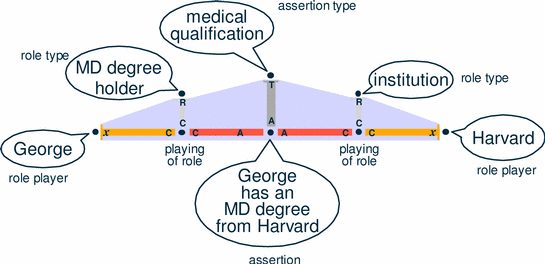
In addition to the six
different subjects already discussed, there are
still two more, each of which is shown as a black
dot where the C endpoints of three different arcs
converge; these are called "casting" nodes. The
subject of the left-hand casting node is the fact
that George plays the "MD degree holder" role in
this particular assertion. The subject of the
right-hand casting node is the fact that Harvard
plays the "institution" role in this particular
assertion. Every assertion asserts a
relationship among its role players, which are
always and only found at the x endpoints
of Cx arcs. Every node (here, every black
dot) can play any number of roles in any number
of assertions. In the very small,
single-assertion topic map graph depicted here,
there are only two role players (George and
Harvard), and each of them plays only one role in
one assertion.
Figure 2:
This diagram shows
the structure of all assertions that have a
specified assertion type, two role types, and
two role players. The structure of a 2-role,
2-role-player assertion with an
unspecified assertion type is the same,
except that the AT arc and the t-node are not
present. The structure of a 2-role,
1-role-player assertion is the same except that
one of the Cx arcs, and the node at its
x endpoint, are not present. Assertions
that have more than two role types have the
same structure, except that for each additional
role type, there is an additional AC arc, an
additional c-node, an additional CR arc, an
additional r-node, and possibly an additional
Cx arc with a role player node serving
as its x endpoint.
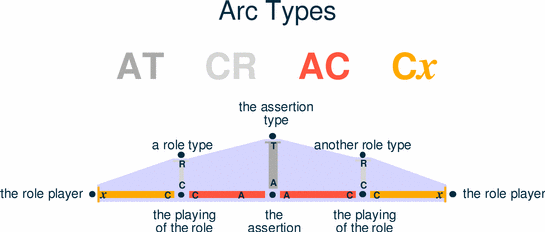
|
Annex C |
Sample properties that
reflect assertion structure (informative)
|
The following list of property
definitions is intended to illustrate how the
internal structure of assertions could be reflected
in a set of property definitions within the
definition of a TM Application.
| Editor's Note 3: |
Consider: should there be a
DTD for TM Application Definitions? If so,
should it be normative or informative?
|
| Editor's Note 4: |
Consider: How often will TM
Applications borrow the definitions provided
here (or definitions like them)? If we
anticipate that they are going to be borrowed,
should we present these definitions as a
normative TM Application? Should the SAM
define them as a separate TM Application module
so that they can be borrowed by TM Applications
that don't want to borrow the entire SAM? If
the SAM defines them (or something like them),
should they appear in the RM at all, even
informatively?
On the other hand, maybe the
SAM won't include such a comprehensive set of
properties for reflecting the structure of
assertions, with full traversibility of all the
arc types. In that case, does it make more
sense for these definitions to appear in the
RM, as they do here?
|
    * Properties for which only a-nodes can exhibit
      values:

        Name: roleCastings
        Value type: node set
        Constraints on values: Only a-nodes exhibit values for this
          property, and all a-nodes must exhibit a value for this property.
          The value must be a set of c-nodes.
        SIDP or OP?: SIDP
        Semantics: The value is the node set which is the set of c-nodes
          that serve as the C endpoints of the set of AC arcs of which the
          a-node serves as the A endpoint.

        Name: assertionType
        Value type: node
        Constraints on values: Only a-nodes exhibit values for this
          property.  The value must be a t-node.
        SIDP or OP?: SIDP
        Semantics: The value is the node, if any, that serves as the T
          endpoint of the AT arc of which the a-node serves as the A
          endpoint.  If no value is exhibited, the assertion type of the
          assertion of which the a-node serves as the nexus is unspecified.

        Name: roleTypes
        Value type: node set
        Constraints on values: Only a-nodes exhibit values for this
          property.  The value must be a set of r-nodes.
        SIDP or OP?: OP
        Semantics: The value is the node set which is the set of r-nodes
          that serve as the R endpoints of the set of RC arcs of which the
          set of c-nodes serve as the C endpoints, which set of c-nodes
          serve as the C endpoints of the set of AC arcs of which the
          a-node serves as the A endpoint.

        Name: players
        Value type: node set

        Constraints on values: Only a-nodes exhibit values for this
          property.  (There are no other constraints; any nodes can be
          members of the node set.)
        SIDP or OP?: OP
        Semantics: The value is the node set which is the set of nodes that
          serve as the x endpoints of the set of Cx arcs of which the set
          of c-nodes serve as the C endpoints, which set of c-nodes serve
          as the C endpoints of the set of AC arcs of which the a-node
          serves as the A endpoint.

    * Properties for which only c-nodes can exhibit
      values:

        Name: rolePlayer
        Value type: node

        Constraints on values: Only c-nodes exhibit values for this
          property.  There are no other constraints; any node can be the
          value.
        SIDP or OP?: SIDP
        Semantics: This property may or may not exhibit a value.  If it
          does, the value is the node, if any, that serves as the x
          endpoint of the Cx arc of which the c-node serves as the C
          endpoint.

        Name: roleType
        Value type: node
        Constraints on values: Only c-nodes exhibit values for this
          property, and all c-nodes must exhibit a value for this property.
          The value must be an r-node.
        SIDP or OP?: SIDP
        Semantics: The value is the node that serves as the R endpoint of
          the CR arc of which the c-node serves as the C endpoint.

        Name: assertion
        Value type: node
        Constraints on values: Only c-nodes exhibit values for this
          property, and all c-nodes must exhibit a value for this property.
          The value must be an a-node.
        SIDP or OP?: SIDP
        Semantics: The value is the node that serves as the A endpoint of
          the AC arc of which the c-node serves as the C endpoint.

    * Properties for which only r-nodes can exhibit
      values:

        Name: castingsOfRole
        Value type: node set

        Constraints on values: Only r-nodes exhibit values for this
          property.  All members of the node set must be c-nodes.
        SIDP or OP?: OP
        Semantics: The value is the node set which is the set of c-nodes
          that serve as the C endpoints of the set of CR arcs of which the
          r-node serves as the R endpoint.

    * Properties for which only t-nodes can exhibit
      values:

        Name: assertionsOfType
        Value type: node set

        Constraints on values: Only t-nodes exhibit values for this
          property, and all t-nodes must (by definition) exhibit a value
          for this property.  All members of the node set must be a-nodes.
        SIDP or OP?: OP
        Semantics: The value is the node set which is the set of a-nodes
          that serve as the A endpoints of the set of AT arcs of which the
          t-node serves as the T endpoint.

    * Properties for which all kinds of nodes
      (including but not limited to a-nodes, c-nodes,
      r-nodes, and t-nodes) can exhibit values:

        Name: rolePlayings
        Value type: node set
        Constraints on values: All nodes in the set must be c-nodes.
        SIDP or OP?: OP
        Semantics: The node set whose members are the c-nodes at the C
          endpoints of the Cx arcs whose x endpoints are the node.  If no
          value is exhibited, then the node plays no roles in any
          assertions.

    * Properties for which only a-nodes, c-nodes,
      r-nodes, and t-nodes can exhibit values:

        Name: nodeType
        Value type: enumeration
        Constraints on values: Value must be one of "assertion", "casting",
          "roleType", or "assertionType"
        SIDP or OP?: SIDP
        Semantics: Exhibits a corresponding value ("assertion", "casting",
          "roleType", or "assertionType") when the node is an a-node,
          c-node, r-node or t-node.  When it exhibits no value, the node is
          neither an a-node, nor a c-node, nor an r-node, nor a t-node.
|